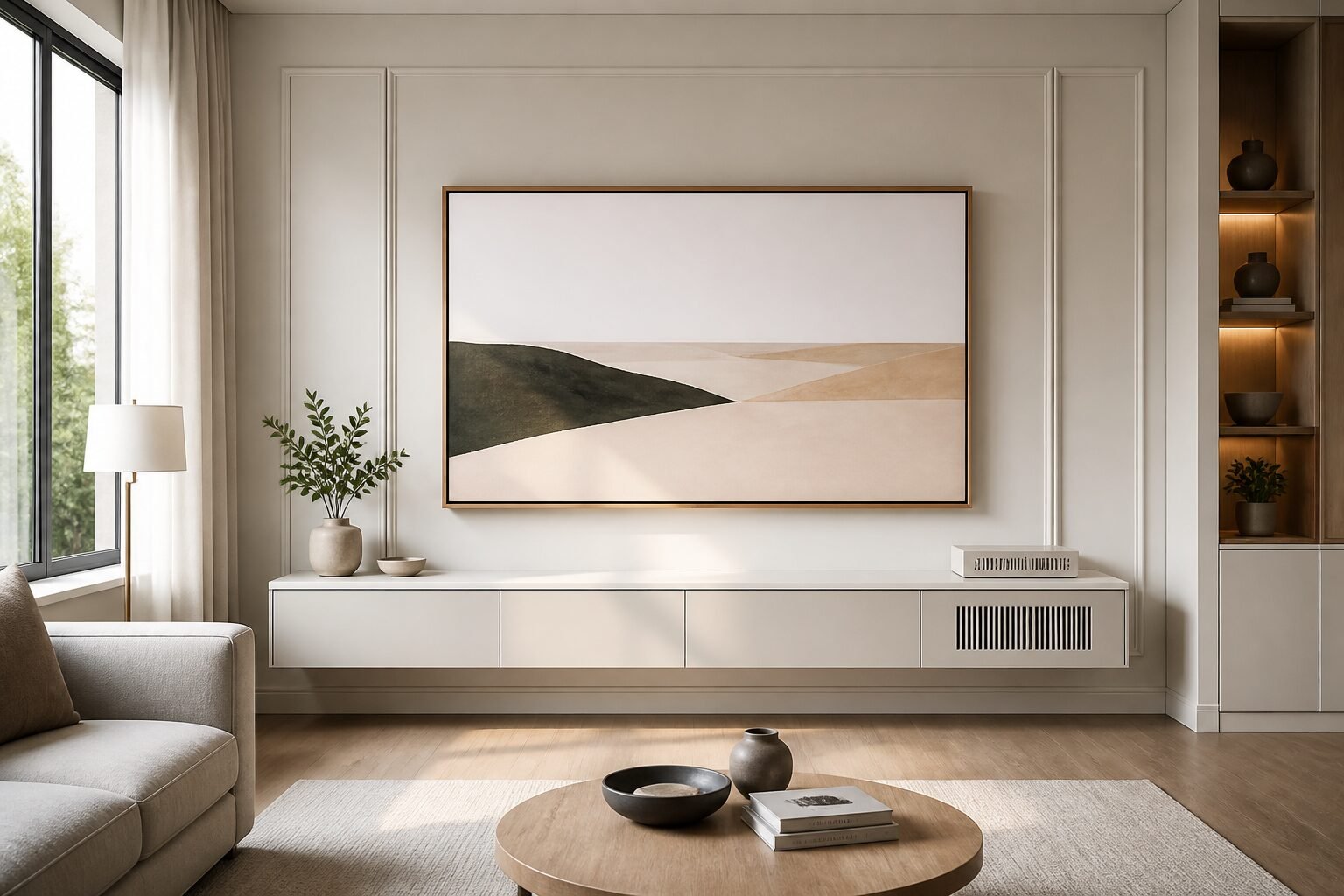
Your living room deserves better than cable spaghetti and a blinking router rave. Let’s turn that tech chaos into a clean, art-forward space where the TV vanishes until showtime. We’ll use hollow paintable baseboards, a custom TV frame that reads like canvas, and a sleek router box that disappears into your decor. No, you don’t need a movie studio budget—just a plan and a paintbrush.
The Vision: From Wire Jungle to Gallery Wall
Most living rooms hide a secret: a tangle of cables drooping off the mantle, coiling under the console, and photobombing every vibe. The TV hangs there with its power cord screaming “notice me,” and the router blinks like a tiny spaceship.
Now picture the opposite. No visible wires. No clunky black boxes. Just art, lighting, and intentional design. We’ll route every cable out of sight, frame the TV so it reads as art, and tuck your router into a breathable, paint-matched enclosure. That’s the glow-up.
Erase The Mess With Hollow Paintable Baseboards
Think of hollow paintable baseboards as cheat codes for invisibility. They look like normal trim, but behind the face lies an open channel to swallow every cord you own.
Why They Work
Built-in cable channel: Slide power, HDMI, and ethernet inside the baseboard, not along the floor.
Paint-to-match: Hit them with the same wall color so they visually disappear.
Clean entry/exit points: Run lines through the wall cavity and pop them out only where needed—behind the TV or console.
Quick Install Game Plan
Measure your cable runs and add 10–15% slack. Future you will thank you.
Cut baseboards to size, pre-drill for clean mounting, and dry fit along your route.
Feed cables through the baseboard channel, then mount to the wall like standard trim.
Caulk the seams, paint to match your wall, and boom—cable chaos gone.
FYI: Keep power and low-voltage lines (like HDMI/ethernet) organized with small clips or sleeves inside the channel so you can service them later without tears.
Make Your TV Read As Art With A Custom Frame
Here’s the centerpiece. Build a simple box frame around your TV so it looks like a stretched canvas on the wall. When it’s off, display a still image or canvas print. When it’s on, the image fills edge to edge and still reads curated, not clunky.
Design Notes That Sell The Illusion
Depth matters: Build the frame deep enough to house the screen and its connectors without bulging.
Matte paint, same tone as walls: Gloss screams “TV.” Matte whispers “art.”
Flush mount inside: Use a thin bracket so the screen sits tight to the backing.
Invisible routing: Run cables through the wall and into your baseboard channel. No dangling anything.
Smart Content For “Off” Mode
Curated art prints or family photos you actually like (no default landscapes, IMO).
A printed canvas backing for non-smart TVs—simple and timeless.
Muted, gallery-style imagery that blends with your palette so the wall stays cohesive.
Pro Tip: Keep the frame’s inner edges tight to the screen, but avoid full contact. A tiny reveal keeps airflow healthy and the illusion crisp.
Hide The Router Without Killing Your Signal
We love fast Wi-Fi. We don’t love staring at a blinking gadget with six arms. Enter the paintable router box: a clean, vented enclosure that blends right into your walls or trim.
What To Look For In A Router Box
Ventilation: Precision slots or perforation on multiple sides so the gear stays cool.
Cable pass-through: A narrow gap at the base to keep cords tidy and hidden.
Paint-ready surface: Match your wall tone and let it visually vanish.
Place it on the console or mount it where the signal stays strong. You’ll get full performance without the “mini server room” look.
IMO: If your router has antennas, angle them inside the box if space allows, or choose a low-profile mesh unit for peak stealth.
Plan The Cable Routes Like A Pro
Design beats improvisation every time. Map how each cable will travel from source to destination before you drill anything.
Simple Routing Blueprint
Sources: Console, media box, gaming gear, router.
Path: Device to wall plate → Baseboard channel → Pop up behind TV/console.
Service loops: Leave a gentle loop of extra cable at each end for easy swaps.
Labels: Tag each cable at both ends. Future upgrades become painless.
Heads-up: Long HDMI runs? Use certified cables or active HDMI to prevent signal loss. Keep power and data lines parallel but slightly separated inside the channel for less interference.
Style It So The TV Disappears
The frame and clean wiring do 80% of the work. Styling does the last 20%.
Build an asymmetrical gallery wall that includes the TV-as-art frame so it blends in.
Use sconces or picture lights to wash the wall and add depth—glare-free bulbs, please.
Match frames or finishes for cohesion: blackened metal, pale oak, or painted to wall tone.
Keep surfaces minimal—hide remotes and hubs in closed storage to preserve the vibe.
FYI: A matte anti-glare screen or ambient mode setting helps the “art” illusion hold up during daylight.
Maintenance And Upgrades Made Easy
A hidden system should still be flexible. You don’t want a sealed tomb; you want a neat backbone you can adjust.
Access points: Leave discreet openings behind the TV and console for quick swaps.
Modular mindset: Choose a frame with a removable side or magnetic face for service.
Ventilation everywhere: TV frames and router boxes need airflow. Silent setups beat hot ones.
FAQ
Will a paintable router box hurt my Wi‑Fi speed?
Short answer: Not if it’s designed well. Pick an enclosure with generous ventilation and non-metal construction, and place it in a central location. Your signal will stay solid while the visual noise disappears.
Can I use hollow baseboards in a rental?
If you can replace trim and repaint when you move, yes. Otherwise, try surface raceways painted to match your walls. They’re not as invisible, but they’re renter-friendly and still clean up the chaos.
How do I stop the TV from overheating inside a frame?
Give it breathing room. Use a slim mount to keep the screen off the backing, leave a small reveal inside the frame, and ensure air can enter at the bottom and exit at the top. Heat rises—let it escape.
What if my cables are too thick for the baseboard channel?
Run bulky power separately and keep low-voltage (HDMI/ethernet) inside the baseboard. You can also split runs across multiple sections or use a slightly deeper profile where needed. Label both ends so you don’t curse your past self later.
Can I do this without building a custom frame?
Absolutely. Buy a pre-made TV frame or a thin bezel kit, then color-match it to your wall. You’ll still get 80% of the look without breaking out the miter saw.
How do I pick art that sells the “TV as canvas” trick?
Choose pieces with soft edges, matte finishes, and a palette that echoes your room. Avoid hyper-saturated screensavers. Moody photography, minimal abstracts, or vintage prints keep the illusion tight.
Conclusion
Hide the tech, keep the function, and let the design breathe. With hollow paintable baseboards, a canvas-style TV frame, and a stealth router box, you’ll trade cable chaos for gallery calm. The screen shows up only when you want it; the rest of the time, your wall reads like art. That’s the secret sauce: intentional choices that make your living room look exactly like you meant it to.